
 +86 13096987266




What Is Liposomal Encapsulation? A Bulk Buyer's Technical Guide
2026-10-10
"Liposomal" is now one of the most common words on an ingredient quotation — and one of the least standardised. In fifteen years of supplying ingredients to supplement, food and cosmetic brands, I have watched buyers accept a liposomal premium without ever asking what it bought them. The material often arrives with a spec sheet that lists an encapsulation figure, a particle size and a carrier, and no explanation of how any of those numbers were produced or what they should be.
 This guide is written for the buying side of the table. It explains what a liposome actually is, which numbers on a liposomal specification are meaningful, why the carrier and the drying format drive stability, how the material is manufactured, and what to request before you commit to a first order.
What a Liposome Actually Is
A liposome is a spherical vesicle built from a phospholipid bilayer — the same kind of structure that makes up a cell membrane. The bilayer is roughly four nanometres thick, and it encloses an aqueous core. That geometry is the entire point: it gives you two places to put an active. Hydrophilic molecules such as vitamin C or glutathione sit in the water core; lipophilic molecules such as curcumin, resveratrol, CoQ10 or vitamin D are carried inside the lipid membrane itself. Liposomal encapsulation is therefore not one product but a platform, and the same carrier chemistry behaves differently depending on which class of active you load into it.
Size and lamellarity decide what the carrier can do
Liposomes are made in three broad structural families. Small unilamellar vesicles (SUVs) are single-bilayer structures of roughly 20–50 nm, with a high surface-to-volume ratio and good performance for lipophilic payloads — but a thin bilayer that leaks water-soluble material. Large unilamellar vesicles (LUVs) hold more aqueous volume and suit hydrophilic actives, at some cost in mechanical robustness. Multilamellar vesicles (MLVs) stack several bilayers, which makes them mechanically stable and gives a more gradual release profile. Published formulation work generally places useful liposomes between 50 and 500 nm, with 10–100 nm considered favourable for cellular interaction and 50–200 nm described as an effective window for systemic delivery. In practice, the buyer's question is not "which size is best" but "which size range has been validated for my active and my dosage form".
The Numbers That Matter on a Liposomal Specification
| Parameter | What it actually states | What to check |
|---|---|---|
| Active content (%) | How much active is in the powder — e.g. "50% liposomal curcumin" | Whether the figure is on a dried basis and how it is assayed |
| Encapsulation efficiency (%) | The share of that active that is genuinely inside the vesicles | That a method is named, and that free active was separated and measured |
| Particle size (nm) | The mean diameter of the vesicle population | A distribution, not a single headline number |
| PDI | Polydispersity index — how uniform that population is | Batch-to-batch consistency over several lots |
| Zeta potential (mV) | Surface charge, which governs colloidal stability | Whether it supports the suspension or blend format you will use |
| Carrier identity and ratio | Which phospholipid carries the active — commonly non-GMO sunflower lecithin | The carrier's own specification and allergen or non-GMO statement |
| Format | Spray-dried powder, liquid suspension or lipid paste | Which one your filling line can actually run |
A real commercial grade, to make this concrete: a 50% liposomal curcumin might be specified as curcuminoids at 50% or above, an encapsulation rate at or above 88%, a uniform particle size in the tens of nanometres, and a non-GMO sunflower lecithin carrier with water dispersibility. Those are supplier-declared figures — the point of this section is that you should be able to ask, for each one, how it was measured.
Encapsulation efficiency is not loading capacity
These two get conflated constantly. Encapsulation efficiency is the proportion of the active that ended up inside the vesicles; loading capacity is how much active the carrier holds relative to its own mass. A grade can show high loading and mediocre efficiency, or the reverse. Methodological reviews are explicit that determining efficiency properly requires quantifying at least two of three populations: total active content, encapsulated active, and free active. If a supplier quotes an efficiency figure without telling you which populations were measured and how they were separated, the number is not verifiable — it is a claim.
Why the Carrier and the Format Decide Stability
Cholesterol, saturation and rigidity
The bilayer's composition sets its physical behaviour. Saturated phospholipids and added cholesterol increase rigidity, which improves structural integrity through processing and reduces leakage of the payload during storage. Unsaturated lipids give a more flexible membrane that handles larger or fragile molecules better, at the cost of oxidation sensitivity. Stabilisers such as trehalose or PEG are added to protect vesicles against aggregation, oxidation and the desiccation stress of drying. When a supplier tells you their liposomal grade is "stable", these are the levers they are actually referring to.
Powder versus liquid
Both formats are commercially supplied, and they are not interchangeable. Liquid dispersions suit ready-to-drink and liquid-fill applications but are the more demanding format: vesicles in water are exposed to hydrolysis, aggregation and microbial risk, and they need cold-chain or preservative strategies. Spray-dried powders, sometimes produced with fluidised-bed coating, convert the dispersion into a dry carrier matrix that is easier to store, blend and fill — and published stability work on dried phospholipid systems shows that storage temperature matters, with material held under refrigeration retaining lower polydispersity and better solubility than product stored at ambient. For a brand filling capsules or stick packs, the powder format is usually the practical answer; for a beverage, it may not be.
How the Material Is Actually Made
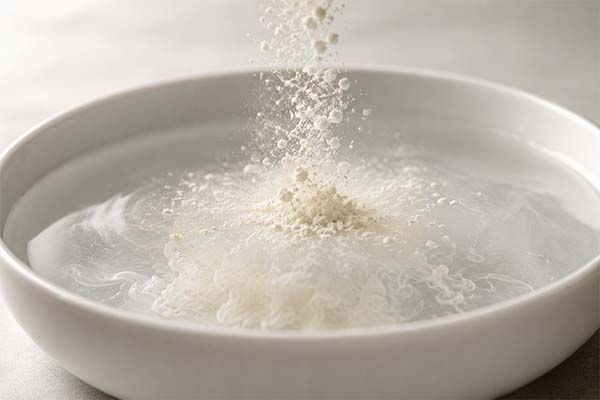
Laboratory routes include thin-film hydration, ethanol injection, sonication and extrusion, with high-pressure homogenisation used to bring particle size down and tighten distribution at scale. Two commercial consequences follow. First, the high-energy steps that create small, uniform vesicles can also drive lipid peroxidation and hydrolysis, so peroxide value and lipid quality are legitimate questions, not academic ones. Second, particle data generated on a pilot batch does not automatically transfer to a commercial batch — a supplier who cannot produce commercial-scale size and PDI data has not finished developing the product. This is also where the cost premium comes from: carrier, energy, drying, and the analytical work to prove all of it, batch after batch.
What to Verify Before You Place an Order
Batch-level particle size, distribution and PDI — from the production scale you are buying, not a pilot lot.
A named encapsulation method — and the raw data behind the efficiency figure.
Carrier specification — identity, ratio, non-GMO statement, and its own COA.
End-of-shelf-life data — not only release data; retest the active content and particle profile at expiry.
Dispersibility test — have your own lab wet the powder out in water and watch for clumping, sedimentation and separation over 24 hours.
Fill trials — bulk density and flow decide whether your capsule or sachet line runs at target speed.
The red flags are consistent: a liposomal premium with no particle data at all; an encapsulation figure quoted with no method; numbers that appear only in a presentation and never on a COA; and a supplier who will not name the production route. Any of those means you are paying for a word rather than a delivery system.
Where Liposomal Encapsulation Earns Its Cost Premium
The technology pays for itself in three situations. First, poor water solubility — lipophilic actives that otherwise settle out of a beverage or blend unevenly gain stable dispersion. Second, actives that are degraded on the way through the digestive tract or heavily metabolised before reaching circulation. Third, formats where the delivery system is the product story: premium capsules, liquid stick packs and practitioner-channel lines. It is not a sensible default for every SKU. A commodity, water-soluble active formulated at low dose into a standard tablet rarely recovers the cost, and adding a carrier at 30–50% of the powder's mass means your formulation has to be re-costed per serving, not per kilogram of active.
Frequently Asked Questions
What does "50% liposomal curcumin" actually mean?
It means the powder contains 50% curcuminoids by assay, with the balance made up largely of the phospholipid carrier and any stabilisers. It does not by itself tell you how much of that 50% is encapsulated — that is what the encapsulation efficiency figure is for.
Is liposomal powder as good as a liquid liposomal product?
For storage and standard solid dosage manufacturing, the powder is generally the more robust choice: dry vesicles avoid hydrolysis and microbial risk and handle better in blending and filling. Liquids can be the better fit for beverage applications. The right answer depends on your dosage form, not on a general ranking.
What particle size should I specify?
Specify the range your supplier has validated for your active and route, and require the distribution and PDI alongside it. Published work places most useful liposomes between 50 and 500 nm, with narrower, smaller populations favoured for cellular interaction — but a tight, reproducible distribution at a moderate size usually outperforms a headline figure with a wide spread.
How do I know the encapsulation efficiency figure is real?
Ask which populations were measured — total, encapsulated and free active — and how they were separated, then request the calculation and the raw data for the lot you are buying. Efficiency is only meaningful when at least two of those three values are quantified by a stated method.
References
Rahim MA, Zahran HA, Jaffar HM, et al. Liposomal Encapsulation in Food Systems: A Review of Formulation, Processing, and Applications. Food Science & Nutrition. 2025;13(8):e70587.
Inside Therapeutics. LNP and liposome characterization guidelines: size, PDI, zeta potential and encapsulation efficiency. 2026.
BOC Sciences. Liposome encapsulation efficiency measurement — efficiency versus loading capacity. 2026.
Methods and advances in the determination of liposomal encapsulation efficiency. Journal of Drug Targeting. 2025.
Liposoma Nutraceuticals. Bulk liposomal ingredients: spray-dried powder, liquid suspension and lipid paste formats. 2026.
Folius Labs. Liposomes in the supplement industry: promise, problems and the truth behind the claims. 2025.
ScienceDirect. Liposomes: bridging the gap from lab to pharmaceuticals. 2024.
We are botanical extract and ingredient manufacturer based in Xi'an, China, with more than 15 years of experience supplying standardized herbal ingredients and delivery-system grades to supplement, food, beverage and cosmetic brands in over 50 countries. We supply liposomal ingredient grades with declared active content, encapsulation data, particle size and PDI on a batch-level COA, together with carrier documentation and support on format selection for your filling line. For a specification sheet, sample or quotation, email sales@kh-health.com or message us on WhatsApp at +86 187 9288 0979.
Hui Ding 16 years in botanical extraction
Scientifically reviewed by the :KH Health Quality Assurance Team (ISO-certified facility)
Published: January 15, 2026 · Updated: August 28, 2026