
 +86 13096987266

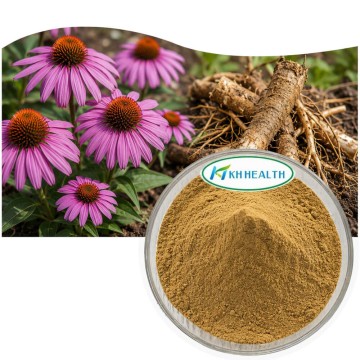
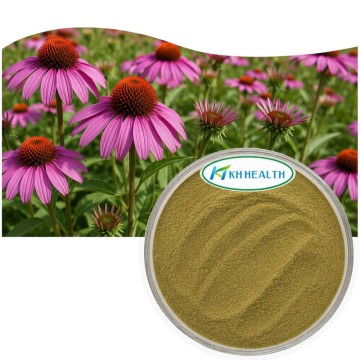
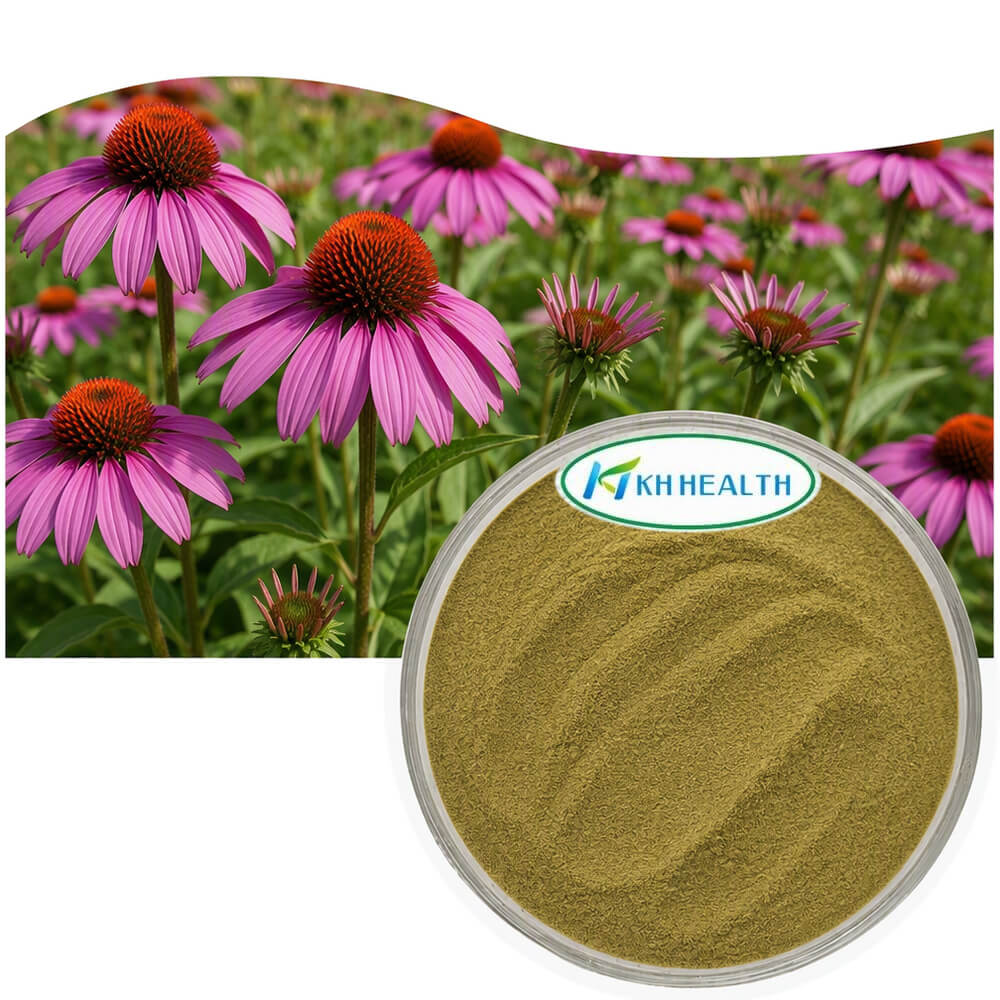
Echinacea Purpurea Extract 4% Cichoric Acid
product description
Echinacea purpurea (L.) extract cichoric acid — a dicaffeoyl ester of tartaric acid, CAS 70831-56-0, molecular weight 474.37, and the dominant caffeic acid derivative in the aerial parts of E. purpurea. It is the polyphenol that carries the plant's hyaluronidase inhibition, its macrophage-activating phagocytosis response and its free-radical scavenging capacity.
This product is extracted under inert atmosphere in a pH-stabilized hydroethanolic system, purified on selective macroporous resin, and released by HPLC at a minimum of 4.0% cichoric acid on a total phenolic matrix of ≥8.0%. It is a fine, uniform yellow-brown to brown powder with a clean herbaceous aroma, a faintly bitter and mildly tart-sweet taste, and a specification that holds its number across the shelf life instead of decaying toward it.
Product Process
Fresh Echinacea purpurea aerial parts (harvested < 2 h)
│
▼
[1] FLASH ENZYME INACTIVATION — saturated steam / microwave blanching
→ PPO and esterase denatured within seconds; > 95% of initial
cichoric acid locked in place before browning can begin
│
▼
[2] Low-Temperature Forced-Air Drying & Stabilized Milling
→ moisture held in a narrow band; no thermal re-activation window
│
▼
[3] Inert-Atmosphere, pH-Stabilized Hydroethanolic Countercurrent Extraction
→ nitrogen blanket, mildly acidic pH, 45–55 °C
→ phenolics taken into solution without quinone polymerization
│
▼
[4] Selective Macroporous Resin Chromatography
→ salts, sugars and mucilaginous polysaccharides stripped away
→ cichoric acid fraction enriched, baseline-clean chromatography
│
▼
[5] Concentrate Polish & Solvent Recovery (low thermal dose)
│
▼
[6] Vacuum Low-Temperature Spray Drying
→ free-flowing yellow-brown powder, no scorch, no caramel note
│
▼
[7]Milling & Classification to 80–100 mesh
Product strength
1. Two-Hour Flash PPO Inactivation
The industry standard — herb wilted and dried for hours or days before processing — allows endogenous enzymes to degrade cichoric acid and oxidize phenolics into brown pigments. Our line blanches harvested aerial parts within two hours of cutting, instantly denaturing PPO and esterases to retain >95% of native cichoric acid. The result: a CoA number that reflects enrichment of live material (not fortification of degraded material), predictable shelf life, and clean colour and taste — essential for gummies, lozenges, and effervescent formats.
2. Inert-Atmosphere, pH-Stabilized Extraction
Phenolic hydroxyls oxidize readily in alkaline, oxygen-rich, high-temperature conditions, forming dark pigments and "cooked" off-flavours. We extract under closed, nitrogen-blanketed, mildly acidic conditions at 45–55 °C — displacing oxygen, protonating phenolics, and capping thermal stress on cichoric acid and alkylamides. Countercurrent staging maximizes yield while minimizing solvent and energy use. The result is a bright extract with a clean phenolic spectrum — capable of going into transparent gummies, white effervescent tablets, and pale lozenges without colour or taste defects.
3. Selective Macroporous Resin Chromatography
Crude echinacea extract is 60–80% non-active mass: salts, sugars, and mucilaginous polysaccharides that cause hygroscopicity, stickiness, and tablet-press failures. Resin chromatography separates phenolic acids (cichoric, caftaric, chlorogenic) from these impurities via aromatic-ring adsorption and size exclusion, then elutes the enriched fraction with graded ethanol. The outcome: ≥4.0% cichoric acid without harsh solvent stripping of alkylamides, and an HPLC chromatogram with a flat baseline and resolved peaks — defensible under audit and visually verifiable by the customer's QC team.
4. Physical Overheated-Steam Sanitization
Gamma irradiation and ethylene oxide are increasingly rejected by EU and premium channels — and both indiscriminately degrade the very phenolic esters and alkylamides that define activity. Our validated closed-system overheated-steam process delivers real log-reduction microbial control with zero ETO residue and zero irradiation. Upstream bioburden control (low-temp drying, closed conveying, filtered air, low-moisture milling) supports the treatment. Every lot carries a signed zero-ETO/non-irradiation statement — a gate requirement for EU, US, Japan, and Korean filings, and a prerequisite for superfood-grade positioning.
5. HPLC Phenolic Fingerprint & Species Authentication
Echinacea is one of the most adulterated botanicals in trade; E. angustifolia and E. pallida can substitute for E. purpurea invisibly on a "total phenolics" certificate. We release against a full phenolic fingerprint — individual quantification of cichoric, caftaric, and chlorogenic acids, echinacoside confirmed absent as a species-purity marker, and whole-chromatogram comparison against retained reference standards. Species identity is independently verified at intake by macroscopic and microscopic ID. Retention samples from every lot are held for full traceability. The buyer gets dose linearity and label integrity: what the label says is what's in the product, batch after batch.
6. Batch Uniformity Written Into the Specification
Botanical projects fail on variance, not on average. A grade that assays 4.6% one month and 3.4% the next forces re-validation of every blend ratio and overage calculation. We control at three points — incoming herb, in-process resin eluate, finished lot — and blend to target rather than reporting whatever the process produces. Assay, total phenols, colour, mesh, moisture, water activity, and bulk density are released with measured values, and a physical sample is retained against every lot number.
Product application
1. Seasonal Immune Drink Mixes, Effervescent Packets & RTD Sticks
Engineered for transparent, clean-label liquid formats. The extract disperses readily in water and water-ethanol systems without leaving film residue, and a granulated, low-dust build enables high-speed VFFS processing. Its faint herbal bitterness reads as authentic "herbal" character in honey-lemon or berry matrices, naturally reducing sweetener load. Crucially, enzyme-inactivated material maintains a clean amber-to-rose tone through shelf life — enabling transparent stick packs rather than opaque alternatives, whereas unblanched extracts turn muddy brown within weeks.
2. Dietary Immune Capsules, Tablets & Chewable Lozenges
Broad format compatibility across capsule, tablet, and chewable platforms. The standard powder fills cleanly in hard capsules without bridging, while a dedicated densified, low-water-activity microgranule grade is engineered specifically for high-speed direct compression — solving the sticking issues commonly caused by natural gum content. For chewables, the herbaceous profile pairs naturally with berry, honey, and citrus flavor systems, with menthol converting residual bitterness into a "throat-coat" sensory signal consumers associate with efficacy.
3. Immune Throat Lozenges, Hard Candies & Gummy Bears
Two distinct technical advantages serve two distinct formats. For hard candy: low moisture content prevents hydrolysis of cichoric acid in the high-temperature glassy matrix, and the clean, low-polysaccharide profile ensures transparency rather than haze. For gummies: the extract delivers no dark specks, no visible sediment, and no color drift in translucent gelatin or pectin matrices — a requirement impossible to meet with crude extracts.
4. Oral Throat Sprays & Mucosal Soothing Formulations
The hydroethanolic-soluble grade dissolves cleanly in low-viscosity aqueous systems (pH 4–6) and maintains long-term clarity — whereas crude spray-dried powders sediment and darken. This makes it uniquely suited for spray formats targeting the oropharyngeal mucosa, where hyaluronidase-inhibition and local barrier mechanisms are most relevant. Pairs naturally with xylitol, glycerin, aloe, sage, or thyme extract for a mucosal-soothing positioning.
5. Companion Animal Immune Support & Respiratory Health
Addresses the premium pet channel's two non-negotiable requirements: palatability (no bitter aftertaste that triggers refusal) and clean processing (low bioburden without irradiation or ETO — a hard gate in premium pet food). The fine powder disperses evenly into chew matrices without speckling, and the same regulatory dossier (heavy metal, microbiological, residual solvent, non-irradiation) serves both human and pet nutrition audits — simplifying supplier qualification across categories.
case study
Premium Organic Gummy & Children's Chew Brand:
A premium brand selling organic gummies and children's chewables wanted to remove synthetic preservatives and move to a "herbal actives only" preservation strategy — a claim rewarded by European and US pharmacy chains, but only if the product still looked and tasted right. Their incumbent crude spray-dried powder brought haze, visible dark sediment, and a persistent bitter-grassy aftertaste into the pectin gummy base, forcing heavy fruit-flavour load and colour overage to hide the defects.
We moved the project to our high-purity, resin-purified 4% cichoric acid micropowder, specified at a fine cut for direct dry blending into the pectin mass. The resin step removed the salts, sugars, and mucilaginous gum that create haze and sediment in aqueous gels, and removed the oxidized, polymerized phenolic fraction responsible for the bitter-grassy note. Because the powder disperses without a hydration step, it could be added late in the process at reduced temperature, minimizing thermal exposure — and the retained cichoric and caftaric acid matrix contributed its own antioxidant function in the gel, enabling synthetic preservative removal.
Outcome. The gummies came out visually clear with no dark specks or bubble-associated sediment, held colour through twelve months at 30 °C, and the sensory panel described the flavour as fruit-forward with a clean herbal finish — the herbaceous character now reading as a plus rather than something to mask. With the synthetic preservative gone, the brand met its clean-label brief.
Frequently Asked Questions (FAQ)
Q1: What is the difference between Echinacea purpurea and Echinacea angustifolia, and why does the marker matter so much?
Cichoric acid marks E. purpurea; echinacoside marks E. angustifolia and E. pallida. A product claiming high levels of both is likely blended or mislabeled. We declare echinacoside non-detectable and provide full phenolic fingerprints with every lot — a "total phenolics" certificate cannot distinguish species.
Q2: How stable is cichoric acid at ambient temperature, and what exactly does PPO inactivation change?
Cichoric acid degrades when endogenous PPO and esterase remain active — hydrolyzing it to caftaric acid and oxidizing into brown pigments. Herb processed >24h after cutting can lose 30–40% before extraction begins. Our flash blanching within 2h of harvest denatures these enzymes, locking in >95% native cichoric acid for a flat 24-month stability curve. Two diagnostics reveal material quality: the caftaric-to-cichoric peak ratio at release, and whether stability is flat or falling.
Q3: Is it water-soluble, and how do I formulate it into a clear drink, a spray or a gummy?
Water-dispersible and hydroethanolic-soluble. For clear drinks: pre-disperse in warm water or glycerin before diluting. For sprays: dissolves at 1–3% w/v in 10–20% ethanol, pH 4–6. For gummies: use resin-purified cut as dry blend added late at low temperature — low gum/salt keeps gels clear. For effervescent tablets: granulate with acid, compress below 25% RH.
Q4: How do I verify species authenticity and guard against adulteration?
Three checks: (1) HPLC fingerprint — cichoric/caftaric/chlorogenic acids resolved, echinacoside non-detectable (purpurea signature); (2) Botanical ID at intake; (3) Alkylamide tingle on the tongue. Red flags: cichoric acid unusually high without supporting matrix (fortification), or large caftaric peak (enzymatic degradation).
Q5: Is the material irradiated or ETO-treated, and what microbiological limits do you release against?
Zero irradiation, zero ETO — ever. Validated overheated-steam sanitization in closed systems with upstream bioburden control. Release: TPC <3,000 cfu/g, yeast/mould <300 cfu/g, pathogens negative. Steam doesn't attack active phenolic esters the way irradiation/ETO do. Signed per-lot declarations standard for EU filings.
Q6: Will it darken or bitter my finished product over shelf life?
Oxidation-driven colour drift and bitterness prevented by: enzyme inactivation at harvest, nitrogen-blanketed extraction at 45–55°C/mildly acidic pH, resin purification to strip oxidized fractions, and low-temp vacuum drying. In finished products: keep moisture low, avoid >60°C in aqueous systems, add late. Verify stability via both colour (Lab*) and HPLC assay.
Q7: What are the MOQ and lead times?
Samples ship within 48h with CoA. Standard grade from 25 kg; custom builds 100–500 kg. Stock: 3–5 days; custom: 10–15 days. Organic: 4–6 weeks. Programme customers receive buffer stock for rapid repeat orders.
For any questions or assistance regarding high-quality echinacea purpurea extract 4% cichoric acid,feel free to contact us via:
Email: sales@kh-health.com
WeChat: +86 13096987266
WhatsApp: +86 18792880979
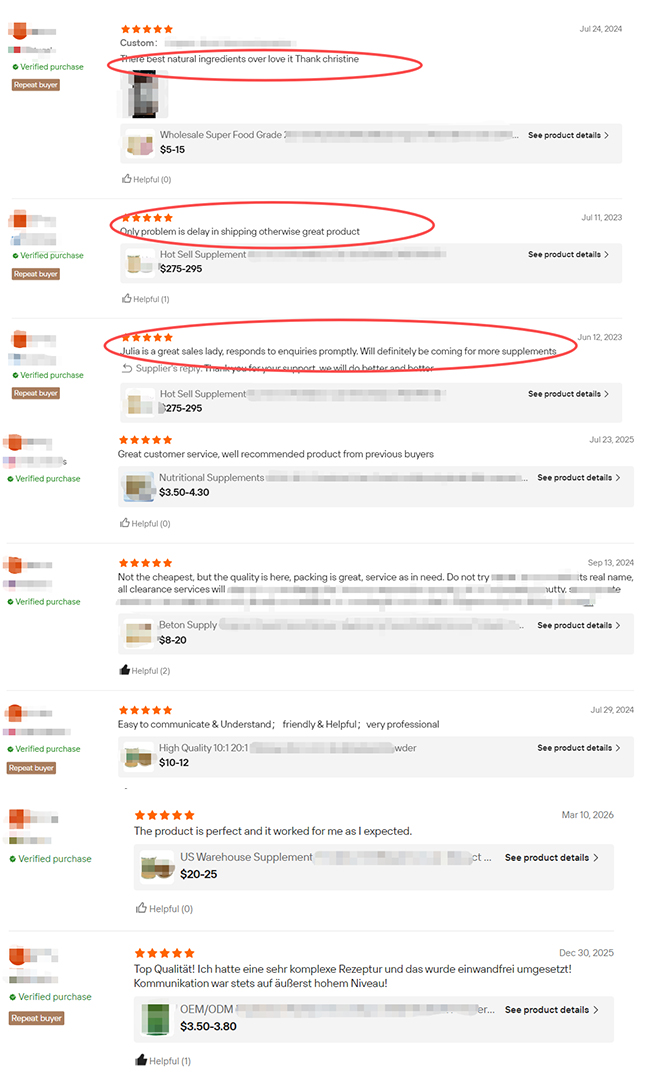
Customers' Feedback
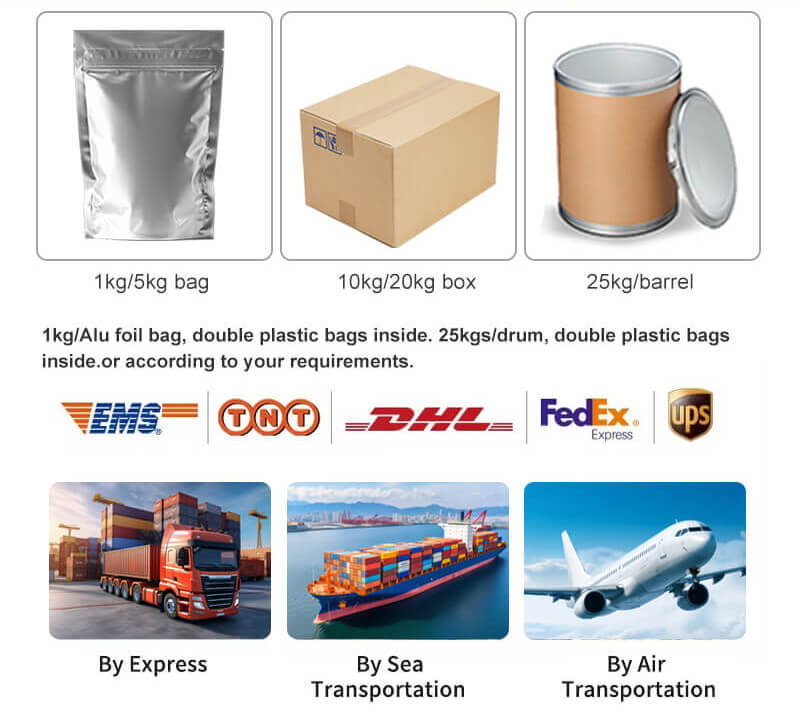
packing and shipping
Inquire Now!
If you have any needs, please feel free to contact me and I will be happy to serve you.